Showing posts with label EBA. Show all posts

Sunday, 19 January 2014

Credit - The Sleepwalkers

"Those who have compared our life to a dream were right... we were sleeping wake, and waking sleep."- Michel de Montaigne 

As 2014, marks the anniversary of probably one of the greatest human tragedy, namely the start of the First World War, we thought our title would reflect one of the greatest book written on the subject on how Europe went to war, "The Sleepwalkers: How Europe Went to War in 1914" by Christopher Clark. In his masterpiece, Christopher Clark analyses what caused the spark that led to the Great War. In similar fashion, we think that there is a possibility some future historian will write an opus on how in 2014 Europe went into deflation but, we ramble again. 

In his book, Clark asserted that the Great War was an entirely avoidable and unnecessary tragedy. "Unintended consequences" of the most colossal sort led to the outbreak of the Great War. In similar fashion the "credit crunch" that plunged Europe into a very deep recession and soaring unemployment levels, we have long argued, was as well an entirely avoidable and unnecessary tragedy. 

What accelerated the "credit crunch" was the EBA's decision for banks to reach a certain capital threshold by June 2012 (for the EBA June 2012 core tier one capital target of 9%, banks needed to raise at least 106 billion euros according to the EBA's calculations):
"If banks cannot access term funding, given the deleveraging they ambition to do, it could put additional pressure on bank lending, in effect reducing access to credit for the economy, namely triggering another credit crunch in the process." - Macronomics, November 2011

We have been sitting in the deflationary camp for a while and while last week, we argued that we could not see a significant drop in the Euro versus the dollar unless the ECB resorted to more "unconventional policies" such as QE. One of the main reasons we cannot fathom a rapid depreciation of the euro comes from the current account balance of the Euro Zone in % of GDP which continues to rise as displayed in recent study done by French bank Natixis in a report published on the 14th of January:
As described in Natixis note, the appreciation of the euro drives a fall in import prices which therefore lowers inflation levels in the Euro Zone. This does increase the deflationary pressure on the Euro zone. Given 73% of the turnover from companies pertaining to the Eurostoxx is coming from outside Europe, this can in turn explains the relative underperformance of European stocks versus the S&P 500 or Nikkei index. European stocks, in similar fashion to Emerging Markets, have as well been the victims of the on-going "currency war".

Looking at the recent discussions surrounding the capital requirement favored by the ECB in the upcoming stress tests, it seems it favors 6% of retained capital, slightly above the 5% used in 2011 during the EBA (European Banking Association) stress tests. Of course, this 6% benchmark must been agreed by the EBA which will coordinate the exams. The slight increase in capital requirement is still below the Comprehensive Assessment (balance sheet review), where the ECB will be using a minimum capital requirement of 8% to evaluate the 130 euro-area lenders under review. The ECB will only become a full member of the EBA when its starts its supervision role later in 2014. 

Still on the regulatory front, the Basel Regulators recent ease of the leverage-ratio rules for banks have not improved financial stability for the near future as reported by Jim Brundsen in Bloomberg on the 13th of January in his article "Basel Regulators Ease Leverage-Ratio Rule for Banks":
"Banks such as BNP Paribas SA, Bank of America Corp. and Citigroup Inc. called for amendments to the draft leverage rule published last year, saying it would adversely affect economic growth and job creation, make it more expensive for governments to sell their debt and give banks incentives to invest in riskier assets." - source Bloomberg.

We touched at length the subject of banks equity buffers in March 2013 in our conversation "Dumb buffers":
"Back in September 2011, we quoted Dr Jochen Felsenheimer from asset management company "assénagon" now called "XAIA", we would like to quote him again looking at the current context:
"Banks employ too much debt, because they know that they will ultimately be bailed out. Governments do exactly the same thing

Banks have fought bitterly against increasing equity buffers which is the cheapest and easiest way to recapitalize banks. Why? Because allowing high payouts to shareholders, namely bank employees in many cases, allows financial institutions to raise their leverage: "Focus on ROE is also a reason bankers find hybrid securities, such as debt that converts to equity under some conditions, more attractive than equity." - Anat R. Admati."

And if leverage is the issue, when it comes to providing loans to the real economy, although there has been some improvement in the euro-zone fragmentation in lending rates between core Europe and the periphery, resolving this divide has yet to be achieved as displayed by Spanish loan rates which have been jumping up as of late:
"ECB President Mario Draghi noted, in comments following November's rate cut, that while euro-zone fragmentation had been improving since mid-2012, progress had foundered since late summer. The latest data on Spanish loan pricing, often cited as a measure of the North-South divide, paint a dark picture. The two-month jump is the biggest increase in more than a decade and will likely stoke fears about this divide, potentially prompting talk of a rate cut." - source Bloomberg.

This fragmentation can as well be ascertained from this graph displaying the interest rate on MFI loans to non financial corporations (1-5 year maturity,

As far as we can see the European "Sleepwalkers" can either provide sufficient ammunitions via the carry trade for banks to rebuild their capital and deleverage, increasing in the process and not severing their fate with their sovereigns, but cannot provide at the same time the necessary credit support to boost economic growth sufficiently in the periphery, therefore not reducing the solvency issue.

For the time being, the situation is one of stability as indicated by the improving sentiment indicator in the Eurozone and Eurozone Real GDP which should improve at least in the short term - graph source Bloomberg:

Due to the fragility of this "recovery", for a change, the less restrictive approach regulatory attitude in relation to banks is supportive of the macro picture. 

We do agree with Bank of America Merrill Lynch Alberto Cordara when it comes to Italian banks from his recent note from the 15th of January entitled "Rules & Recovery":
"Sovereign spreads on a normalisation trail
Italy was hit hard by the crisis, suffering from the malaise spread by the Greek debacle, the collapse of the Spanish real estate market and in our view, the political quagmire of mid-2011. Italy, the third-largest Eurozone economy, has a strong and diversified industrial backbone, individual wealth is high and households are underleveraged. So far, the Italian government has seemed reluctant to implement structural reforms, which have come under fire from the traditional lobbies. In our view, the recent change of guard in the Democratic Party bodes well for reforms, in particular for the labour market, which is in need of modernisation. We think this may lead to further tightening of Italy’s spreads (still higher than in mid-2011).

A punitive regulatory attitude would be plainly ineffective 
As we highlighted in Breaking with tradition 18 October 2013 Italian banks’ lending businesses are currently loss-making and are thus subsidised by profits from elsewhere (AM, product placings, sovereign carry trades). Banks have been damaged by i) high sovereign spreads affecting their ability to issue term funding, and ii) low ECB rates which destroyed their ability to extract margins from depositors. Both variables are exogenous to banks (i.e. not related to their credit worthiness). We do not believe an increase in capital requirements would help address these issues.

Domestic authorities set out a favourable backdrop
We believe that the best way to reactivate the lending cycle is to allow banks to extract more profits, loosen capital requirements and (to a degree) front-load future losses. Recent steps by Italy’s authorities are supportive allowing full tax deductibility of credit losses, a shortening of the DTA amortisation cycle (from 18 to five years), and turning existing IRAP goodwill DTAs into tax receivables, while AFS sovereign losses will continue to be sterilised. Further, banks may ultimately be allowed to benefit from the revaluation of BOI stakes. On the other hand, it stands to reason that banks will be pushed to a credit clean up in 4Q13 as part of the AQR." - source Bank of America Merrill Lynch

When it comes to Italy Bank of America Merrill Lynch makes the following important points:
"In contrast with the rest of the Eurozone, Italy remained in recession in Q3 with unemployment at 12.5% and GDP growth contracting by 0.1% (-1.9% yoy) albeit at a softer pace (Q2: -0.3%; Q1: -0.6%). The overall framework for recovery remains fragile but signs are emerging. Business confidence is improving steadily and industrial production turned positive in November (+1.4% after 26 consecutive months of decline). On latest available data (June 2013), household gross wealth declined by 1% mainly as a result of a fall in house prices, but this was also counterbalanced by a fall in financial debt that currently stands at around 65% of disposable income compared with about 80% in France and Germany and 120% in Spain. Only 25% of Italian households have financial debt and the share of financially vulnerable households is low (3%). Italy’s historically high saving rates have contributed to the formation of a relatively high stock of wealth and a high degree of wealth dispersion among the population." - source Bank of America Merrill Lynch


In relation to Italian banks, the situation is much more different than the poor lending standards and risky loans and real estate exposure which decimated the Irish and Spanish banking sector as pointed out by Bank of America Merrill Lynch's note:
"Capital not the answer although politically appealing
In theory, more capital may help reduce funding costs for those banks that are issuing at a premium to sovereign spreads and potentially reactivate lending to the economy. However, experience suggests that the end result may be exactly the opposite. Higher capital requirements mean that banks are pushed to enforce stricter lending criteria and will adopt suboptimal practices to satisfy the regulator and avoid shareholder dilution. This goes beyond the check dates outlined by the regulator as there is always the risk that the regulator may come back asking for more (this has happened every time…).
The Italian case is very telling: in early/mid-2011, most Italian banks (BP, UBI, ISP and MPS) carried out massive recapitalisations, which proved completely ineffective as funding costs skyrocketed when the price of Italy’s sovereign bonds hit the skids in July 2011. In other words, banks are price-takers and are impacted by Italy’s sovereign – probably a different situation to in Spain and Ireland where poor lending standards and the collapse of the real estate markets were the very epicentre of the crisis. This is also very different from the US situation where TARP was introduced and is often cited as an example of regulatory foresightedness, a panacea for all ills. Italy’s problem resides with the country’s high level of public debt and disappointing ruling class, not with bad banks’ underwriting nor obscure asset values (subprime, etc.)." - source Bank of America Merrill Lynch

While the "stabilisation" is a welcome respite in the Euro-zone, our European "Sleepwalkers" should not take this recovery for granted and continue to push forward for some additional much needed structural reforms, in particular for France which as of late has been significantly lagging its European peers. Nevertheless the increase in European Consumer Confidence has been reflected as well in the EU27 new passenger car registration increases - graph source Bloomberg:

Credit wise, the correlation between the US, High Yield and equities (S&P 500) since the beginning of the year is back on track. US investment grade ETF LQD is more sensitive to interest rate risk than its High Yield ETF counterpart HYG  - source Bloomberg:

What caught our attention is Credit Indices, when one look at the positioning of credit investors, as displayed in a recent note from Morgan Stanley entitled "The Future of the CDS Market", US investors are net long credit risk in the US, particularly in Investment Grade via the CDX IG index:
"In terms of positioning, investors are net long credit risk in the US, particularly in IG (via a net short position of $40 billion in CDX IG). As such, there is some demand from index users to be simply long the market in an unstructured form via the indices." - source Morgan Stanley.

2014, is indeed a continuation of 2013, namely that the liquidity backstop continues to provide ample support for a continuation of carry trades, releveraging and an increase in the search for yield in the riskier part of the credit space as indicated by Lisa Abramowicz in Bloomberg on the 15th of January in her article entitled "Firms Tripling Junk Returns Lure Most Since '07":
"Firms that use borrowed money to lend to the smallest and riskiest companies are attracting cash at the fastest pace since before the crisis, wooing buyers with returns that are triple those of the broader junk-debt market.
Investors from retirees to wealthy individuals plowed $4.1 billion into publicly traded business development corporations last year, the most since 2007, as the firms known as BDCs gained an average 16.4 percent. The entities are juicing returns by borrowing about 50 cents for every dollar raised from equity investors, up from 36 cents in 2011, as Keefe, Bruyette & Woods predicts average gains of as much as 13 percent this year.
BDC shareholders are wagering that an accelerating economy will bolster earnings for companies that are the most vulnerable to default, even as the Federal Reserve starts scaling back the unprecedented stimulus that suppressed borrowing costs. After shunning funds that used derivatives and leverage in the years after the 2008 credit crisis, buyers are returning to pad yields that reached record lows last year while seeking shelter from bonds that face losses as rates now rise." - source Bloomberg.

So we wonder if investors are not indeed indulging themselves into "sleepwalking", although generally sleepwalking cases consist of simple, repeated behaviours, there are occasionally reports of people performing complex behaviours while asleep. 

On  a final note, and in relation to our European Sleepwalkers, the recent surge of the EONIA and Euribor, seems to point to some additional concerns when it comes to credit supply in the Euro area as shown in this Bloomberg graph highlighting the rise of the EONIA index and Euribor:
"The decline in excess liquidity in the euro region, driven by a decision by southern European banks to repay LTRO cash early, is raising key short-term interest rates, threatening the supply and cost of credit to Europe's struggling small- and medium-sized companies. A near doubling of one-month Euribor and EONIA since late November poses a growing threat, even though the ECB has pledged to do whatever necessary, including further rate cuts, to defend the euro zone's recovery." - source Bloomberg.

Let's hope Mario Draghi is not sleepwalking towards the deflationary slippery slope.

"Each man should frame life so that at some future hour fact and his dreaming meet." - Victor Hugo 

Stay tuned!

Thursday, 16 May 2013

Chart of the Day - Too many European banks and why the deleveraging has only just started


"Now this is not the end. It is not even the beginning of the end. But it is, perhaps, the end of the beginning." - Winston Churchill 

This chart of the Day extracted from Bank of America's note Banking on the Banks from the 16th of May clearly illustrate why the deleveraging has only just started in Europe:
"Meanwhile, Europe continues to lag the improvements seen in the US economy and markets. Quite simply, Europe's economy struggles with too many banks, too much debt and too little growth. A long history of empire, trade, war and commerce means a long history of banking. The world’s first state-guaranteed bank was the Bank of Venice, founded in 1157, and the world’s oldest bank today is also Italian, Monte Paschi di Siena (founded 1472). In many European countries, bank assets dwarf the size of the local economy and are far in excess of other regions in the world." - source Bank of America Merrill Lynch.


Why the credit crunch in European countries?
Because this deleveraging was as well accelerated by the fateful decision taken by the European Banking Association  of imposing European banks to reach a Core Tier 1 capital ratio of 9% by June 2012. It has not only broken the credit transmission mechanism to the real economy in Europe but as well caused a credit crunch:
- source Bank of America Merrill Lynch

"What we call the beginning is often the end. And to make an end is to make a beginning. The end is where we start from." - T. S. Eliot 


Stay tuned!

Saturday, 23 March 2013

Credit - The Doubt in the Shadow‏

"Truth is beautiful, without doubt; but so are lies." - Ralph Waldo Emerson, American poet.

Looking at the deposit-levy fallout in Cyprus and the rising concerns about the sanctity of European deposits as whole, we thought this week that our title analogy should be on two levels.

Our title is first and foremost a veiled reference to the 1943 Alfred Hitchcock movie "Shadow of a Doubt".

Let us explain our "twisted" analogy. In the movie, Charlotte "Charlie" Newton always complained that nothing seemed to be happening in her life until her uncle Charlie Oakley paid her a visit (the European Troika). Charlie Oakley, in the movie is suspected of being a serial killer known as the "Merry Widow Murderer", who seduces, steals from, and murders wealthy widows. At first young Charlie refused to even consider the police's claims that her uncle is the man they are looking for. Her suspicion grows, and her uncle finally spilled the beans and admitted to her that he was the man the police were looking for aka the serial killer. He begged her for help and she resigned herself to keep the horrible scandal secret in order to avoid her family being destroyed (the European Union). Uncle Charlie is delighted in the movie to be off the hook, but, knowing that young Charlie knows all his secrets, he decided to get rid of her. In Hitchcock's movie, Uncle Charlie failed the assassination attempt on his niece and died. But, young Charlie ended up resolved to keep her uncle's crimes secret in the end.

Of course, the first level of our analogy with the deposit-levy and capital control imposed in Cyprus by the European Troika visit is purely fortuitous, but, the second level of this week's title analogy resides in the doubts we have in shadow banking in general, and banks' capital in particular, in continuation of last week's conversation "Dumb Buffers".

We have regularly indicated that, like any good behavioral therapist, we always prefer to focus on the process rather than the content. 

In relation to the Cyprus outrage on the deposit-levy, we think it is entirely "misdirected". What the outrage should be all about is that, as we posited last week, (and in agreement with Bloomberg editors views, Simon Johnson, the MIT professor and Stanford University professor Anat R. Admati), the lack of sufficient equity buffers in banks, means no doubt, that banks are indeed the "serial economic killers" of this world, or "Merry Widow Murderers". As indicated by Ben Moshinsky in his Bloomberg article "Big Banks had $269.2 Billion Basel III Shortfall in Mid-2012":
"The largest global banks would have needed an extra 208.2 billion euros ($269.2 billion) in their core reserves to meet so-called Basel III capital rules had the standards been enforced in June 2012, increasing capital levels by about 166 billion euros from the end of the previous year.
Global banks also had an average leverage ratio of 3.8 percent versus a target of 3 percent ratio for banks’ equity to debt, the Basel Committee on Banking Supervision said today in a statement on its website. The Basel measures are scheduled to be phased in by 2019.“The Committee appreciates the significant efforts
contributed by both banks and national supervisors to this ongoing data collection exercise,” the Basel group said.
Global regulators have clashed with lenders over the severity of the capital and liquidity rules, which were set out in 2010 as part of an overhaul of banking regulation in the wake of the financial crisis that followed the collapse of Lehman Brothers Holdings Inc. The Basel III measures will more than triple the core capital that lenders must hold to at least 7 percent of their assets, weighted for risk.
The biggest lenders in Europe would have needed a combined 112.4 billion euros to reach the core tier one capital target of 7 percent, the European Banking Authority said in a separate statement today.
Both the EU and the U.S. missed a January 2013 deadline to begin phasing in the standards, and have said they will seek to apply them from next year.
The lenders surveyed also needed a combined 2.4 trillion euros to meet another liquidity rule set by the Basel committee, which would force banks to back long-term lending with funds that are unlikely to dry up in a crisis.
Banks can address shortfalls in meeting capital requirements by either boosting their reserves or by reducing their assets weighed for risk. "

And, in similar fashion to Uncle Charlie in Hitchcock's movie, the Charlie Oakleys of this world, namely  banks, have indeed been let off the proverbial hook.

This week we will again focus our attention on the banking sector in particular. 

In October 2011, we argued that the markets were long hope and short faith, we also looked at bank recapitalization and in particular professor Anat R. Admati's work. 
On numerous occasions she voiced her opinion on the lack of equity buffer for banks. Specifically she wrote a column in Bloomberg on the 25th of February 2011 on that very subject entitled - "Fed Runs Scared With Boost to Bank Dividends: Anat R. Admati":
"While equity is used extensively to fund productive business, bankers hate to use it. With more equity, banks have to “own” not only the upside but also more of the downside of the risks they take. They have to provide a cushion at their own expense to reduce the risk of default, rather than rely on insurers and eventually taxpayers to protect them and their creditors if things don’t work out.

Fixation with return on equity also contributes to bankers’ love of leverage because higher leverage mechanically increases ROE, whether or not true value is generated. This is because higher leverage increases the risk of equity, and thus its required return. Focus on ROE is also a reason bankers find hybrid securities, such as debt that converts to equity under some conditions, more attractive than equity."

Truth is bank debt is indeed a much larger universe than equity, no question there in the capital structure in the banking space:
"However, bank shareholders’ equity represents typically just around 5% of total balance sheet and c. 25% of investable liabilities. Other main investable liabilities include Basel 3 compliant Alternative Tier 1 (eg, including some contingent convertibles (Cocos)), Basel 3 compliant Tier 2 (including some former hybrids), non-Basel 3-qualifying subordinated debt (some former hybrids that counted as Tier 1 or upper/lower Tier 2 (LT2) debt under Basel 2.5), senior unsecured debt and covered bonds. Future resolution legislation could lead to the creation of new classes of ‘bail-inable’ debt." - source Nomura, European Banks - Navigating the liabilities - 30th of November 2012.

Anat Admati concluded her Bloomberg column of 2011 by adding:

"The muddled debate on capital regulation has left us with only minor tweaks to flawed regulations, even after banks’ catastrophic failure in the crisis and the lasting consequences for the economy. The proposed solutions that regulators in the U.S. are focused on, such as resolution mechanisms, bail-ins, contingent capital and living wills, are based on false hopes. They can’t be relied on to prevent a crisis. Increasing equity funding is simpler and better than these pie-in-the-sky ideas."

In addition to the delays in implementing much needed regulations, banks have been using CDS to lower their capital requirements, as indicated by Jim Brundsen in a Bloomberg article from the 22nd of March entitled - Banks' Use of CDS to Lower Capital Targeted by Basel Regulators:
"Global regulators are planning to crack down on banks that underestimate their capital requirements because of the way they use credit-default swaps and other instruments to lower the amount of risk on their books.
The Basel Committee on Banking Supervision said today that it would seek to stop banks from lowering capital charges by buying instruments such as CDS to insure themselves against losses, while failing to recognize the large liabilities they incur from what they pay for this protection, the group said in a statement on its website.
“The proposed changes are intended to ensure that the costs, and not just the benefits of purchased credit protection are appropriately recognized in regulatory capital,” the Basel, Switzerland-based group of international regulators said in a statement. There exists a “potential for capital arbitrage” as banks can book the benefits of these deals without also booking the associated costs, the group said.
The measure is one of many developed by global regulators to bolster banks’ solvency after the financial crisis. For banks, such credit-protection transactions offer a way to redeploy capital more profitably while meeting the stiffer requirements of the latest round of Basel rules.
Critics say the practice doesn’t make the lenders any safer and pushes the lending risk into the unregulated shadow-banking industry.
Blackstone Group LP, the world’s largest private-equity firm, last year insured Citigroup Inc. against any initial losses on a $1.2 billion pool of shipping loans. The regulatory capital trade, Blackstone’s first, let Citigroup cut how much it sets aside to cover defaults by as much as 96 percent, while keeping the loans on its balance sheet, according to two people with knowledge of the transaction." - source Bloomberg

On top of the use of CDS to massage "capital requirements", the 2012 losses from JP Morgan CIO office also shows the inefficiency of the enforcement of the 2010 Dodd-Frank Act derivatives rule given the lack of transparency and clarity of the information received by the CFTC (Commodity and Futures Trading Commission) from the repositories such as the DTCC (Depository Trust and Clearing Corp) as reported by Silla Brush on the 19th of March in Bloomberg - Dodd-Frank Swap Data Fails to Catch JPMorgan Whale, O’Malia Says:
"Swap-trade data the agency has been receiving since the end of last year from repositories including the Depository Trust and Clearing Corp. is inadequate to identify large positions and have overwhelmed government computer systems, O’Malia said in a speech prepared for a Securities Industry and Financial Markets Association conference in Phoenix.
The data “is not usable in its current form,” said O’Malia, 45, one of the agency’s five commissioners. “The problem is so bad that staff have indicated that they currently cannot find the London Whale in the current data files.” JP Morgan, regarded on Wall Street as one of the best- managed banks in the world, lost more than $6.2 billion last year in a derivatives bet on companies’ creditworthiness that reached a net notional value of $157 billion.
Dodd-Frank was enacted in part to give regulators better oversight of the $639 trillion global swaps market after largely unregulated trades help fuel the 2008 credit crisis. The CFTC and Securities and Exchange Commission were granted authority to write rules requiring trade information to be reported to so-called swap data repositories that function as central record keepers." - source Bloomberg

O'Malia also added in the same article:
"“It means that for each category of swap identified by the 70-plus reporting swap dealers, those swaps will be reported in 70-plus different data formats because each swap dealer has its own proprietary data format it uses in its internal systems,” he said. “The permutations of data language are staggering. Doesn’t that sound like a reporting nightmare?” The CFTC’s computer systems are failing to handle the incoming data. “None of our computer programs load this data without crashing,” O’Malia said."

Hence our "doubt in the shadow" reference in our title. Oh well...

One of our recurring themes in our numerous conversations has been around the "accounting tricks" which have been played by banks in relation to capital requirements. The June 2011 Basel 3 monitoring exercise by the EBA showed that large European banks were short of EUR 242 billion of capital to meet CET1 requirements including the G-SIB surcharge (The regulations require a further 1.5% of ‘Additional Tier 1’ plus a further 2.0% of Tier 2, for Global Systemically Important Banks).

Of course reaching the overly ambitious targets for June 2012 have meant credit contraction in peripheral countries such as Portugal where Portuguese banks are still on "IV" (Intravenous therapy) support from the ECB as reported by Anabela Reis in Bloomberg on March 20 - Portuguese Banks Stay Hooked on ECB Feeding Cash:
"ECB lending slipped to 49.51 billion euros ($64 billion) last month, down 0.4 percent from January, the Bank of Portugal said on March 12. While that was the least in a year, ECB money still accounts for a larger proportion of the financial industry’s assets in Portugal than Ireland, the epicenter of the euro region’s worst banking crisis to date. The ECB’s credit line to Portuguese banks in January was 49.7 billion euros, or 9 percent of their total assets, according to central bank data compiled by Bloomberg. Spain relies on the funding for 9.9 percent of its assets, with the figure 6.1 percent in Ireland."
The ECB provided 841 billion euros of emergency funding to periphery banks at the end of January, according to the latest central bank data available. That’s down from a peak of 977 billion euros in August as reported by Bloomberg.

The on-going deleveraging - source Morgan Stanley Research:


European banks are indeed trying to clean up their balance sheets, spreading, no doubt the cost across shareholders (debt-to-equity swaps, or right issues such as the recent one announced by the second largest German bank Commerzbank with its equity share tanking by 17% in the process), bondholders (bond tenders or junior subordinated debt wipe-outs such as SNS) and now even with depositors (Cyprus).

As a reminder, here are a few illustrations of some of these accounting tricks enabling either boosting capital requirements or boosting earnings which we have discussed in the past.

Liability management:
Banks may have an incentive to buy back non-compliant Basel 2.5 hybrids that do not qualify as regulatory capital under Basel 3. To the extent that such "liability management exercises" can result in debt being repurchased at a discount to par (well below a cash price of 100), banks are able to generate common equity Tier 1 (CET1) gains. On that subject see our October 2011 conversation "Subordinated debt-love me tender?".
Recently Spanish banking giant Santander has been trying to get junior bondholders to contribute to the balance sheet clean-up of its liability structure but not encountering the same level of success it had in 2012. We illustrated the game played by Santander in our August 2012 conversation "Banker's algorithm":
"Credit wise, while in our last conversation "Desperado" on the 21st of August  we touched on Santander 2 year senior unsecured 2 billion euro new issue, which had been the first Spanish bank to issue since mid-march, we were taken aback by the latest "liability management" exercise which Santander followed immediately after its new issuer with. Banco Santander and Santander Financial Exchanges (each an Offeror and jointly the Offerors) inviting holders of certain Tier 1, Upper Tier 2 and Lower Tier 2 securities to tender such securities for purchase for cash at prices to be determined pursuant to an Unmodified Dutch Auction Procedure (as such term is defined in this Tender Offer Memorandum). The maximum aggregate principal amount of Securities that the Offerors intend to accept for purchase jointly pursuant to the Offers, will be an amount equivalent to €2,000,000,000." - source Macronomics
While bond tenders for Santander were so "2012ish", it ain't so much in 2013 given that the acceptance level of the recent proposed "hair cut" on the main GBP/Eur part of the bond tender offer was only 7% in aggregate with sterling bond holders more eager to get the "shaving" treatment with 30% accepting the proposed terms according to CreditSights in their recent Euro Financial Movers report from the 17th of March 2013 - The Week Before Cyprus.

Goodwill write-downs and the beauty of tax credits:
Back in 2012 we indicated that BBVA took a Goodwill impairment charge of 1.5 billion euros in January 2012, which according to CreditSights counter-intuitively helps improved its regulatory capital by generating an immediate tax credit:
"The 400 million Euros tax credit is offset against current taxation and relates to a gross goodwill impairment charge of about 1.5 billion euros rather than 1.1 billion euros, because of rounding differences. 400 million euros equates to an increase in retained earnings flowing into Core Tier One versus the retained earnings that would have been achieved without the goodwill impairment of the tax credit. This is because the gross impairment of 1.5 billion euros does not affect Core Tier 1, since all outstanding goodwill is already discounted in the regulatory number, even though in accounting terms, shareholders'equity will be negatively affected on the balance sheet. The benefit in ratio terms is 14-15 bps worth of Core Tier 1(which stood at euros 25,979 million at 30 September under the EBA Criteria).
Our understanding is that BBVA will be able to offset this against tax payable for the whole of 2011. Although a tax charge is accrued quarterly in the P&L, it is actually paid on an annual basis, so the lack of sufficient pre-tax earnings in the fourth quarter alone should not prevent the group from offsetting the 400 millions euros against the tax that will be payable on the full-year 2011 earnings."

While it was a Spanish trick in 2012, in 2013 it is an interesting Italian trick. Unicredit in its 4Q12 earnings statement reported losses at -€553m vs. -€173m company's gathered consensus it could have been much worse:
"Goodwill tax redemption (DTAs) saves the day:
The results were marked by a very high credit loss charge at €4.6bn which was however partly offset by c. €2bn goodwill tax redemption. Lower yoy costs were a positive but management guided to a flattish 12-13 cost line. In 4Q12 revenues dropped a significant 6% yoy and qoq (NII >€200m lower qoq)" - source Bank of America Merrill Lynch - Alberto Cordara - The Cost of deleveraging - 18th of March 2013

So, no earnings mean no Goodwill impairment impact on earnings and a "convenient tax credit" in conjunction with an improved regulatory capital:

"Losses at -€553m were worse than expectations but capital impact was contained with a B3 fully phased common equity at 9.2% (9.3% in 3Q12) while B2.5 core tier I was slightly higher. UCG was able to offset a high credit charge at -€4.6bn with DTA generated by the goodwill tax redemption (€2bn = €3.9bn – €1.9bn substitute tax).
Capital position:
Basel 2.5 core Tier 1 improved to 10.84% despite a negative earnings impact (-17bps) thanks to lower RWA (+24bps) and other actions at 10bps. The bank stated to be at 9.2% fully-phased Basle 3 lower than in 3Q12 (9.3%) probably on account of higher DTA deductions. " - source Bank of America Merrill Lynch - Alberto Cordara - The Cost of deleveraging - 18th of March 2013
For more on goodwill, see our post from November 2011 - Goodwill Hunting Redux.

Earnings boosting techniques - FAS 159:
In July 2010 we commented on the above: "Statement 159 - Debt Valuation Adjustments - Déjà Vu 2008"
"Statement 159, adopted by the Financial Accounting Standards Board in 2007 allows banks to book profits when the value of their bonds falls from par. This rule expanded the daily marking of banks’ trading assets to their liabilities, under the theory that a profit would be realized if the debt were bought back at a discount."

And  we wrote more on the subject in October 2011 - For whom the vol tolls and the return of FAS 159.
Bank Profits Depend on Debt-Writedown ‘Abomination’ in Forecast - Bloomberg July 2010:
"To the extent that the earnings power is less, the banks would not generate as much capital, so there’s less capital available to absorb future losses." - Credit Agricole Securities USA analyst Michael Mayo
Any similarities to today's situation are of course purely fortuitous. As a reminder from David Hendler, Senior Analyst from CreditSights did sum it up nicely in the same Bloomberg article around FAS 159:

"When the prevailing winds of credit spreads tighten, they make a lot of money, and when spreads widen, they can’t make as much." 
Of course the on-going discussions surrounding the most recent tool in liability management being deposits, the risk of letting the genie out of the bottle is raising fears of contagion across Portugal and Spain as indicated by Bloomberg:

"A controversial bank-deposit levy to raise 5.8 billion euros ($7.5 billion) of a 10 billion euro Cypriot rescue package raised fears of bank runs across Southern euro zone nations. While the proposed 6.75% levy on deposits of 100,000 euros or less may be amended to shift a greater burden to larger accounts, it could still prompt deposit runs in Portugal or Spain. That would drive CDS levels higher, raising funding costs for both sovereigns and banks." -source Bloomberg.

A total of 378 billion euros was pulled from banks in so-called peripheral countries -- Ireland, Spain, Portugal, Greece and Italy -- in the 13 months through August, according to data compiled by Bloomberg. 

But the Cyprus situation is not unique: 
"In 2011, Denmark became the first EU nation to bail-in bank depositors when it forced some Amagerbanken A/S savers and senior creditors to share losses. While the move affected only depositors holding more than the EU insurance limit, it left its mark on Danish banks by increasing borrowing costs.Outside the EU, Iceland decided to pay domestic depositors only after the country allowed its banks to fail, leaving out about $5 billion of deposits collected in the U.K. and the Netherlands. The British and Dutch governments made depositors in those countries whole and demanded payment from Iceland.
The almost blanket protection of depositors has been one reason withdrawals from banks in the periphery haven’t soared. Another is higher interest rates paid on deposits. Lenders in those countries and Cyprus are paying customers 3 percent to 5 percent interest on savings, compared with about 1 percent by German banks and 0.5 percent in Belgium, according to ECB data." - source Bloomberg - EU Getting Closer to Bank Union Fails to Help Cyprus Crisis.

Talking about regulations and banks, being "serial economic killers" in true Charlie Oakley fashion, although Denmark was the first EU nation to imposed bail-in, the lack of equity buffers in banks are indeed a serious threat even for Denmark given Danish borrowers are starting to struggle on their interest-only mortgages with a deepening property slump as reported by Frances Schwartzkopff on the 19th of March in Bloomberg - Denmark Races to Prevent Foreclosures as Home Prices Sink:
"The Association of Danish Mortgage Banks and the Mortgage Bankers’ Federation are due to start talks with Business Minister Annette Vilhelmsen to decide how to treat borrowers who won’t be able to afford the interest-only loans they took out a decade ago once amortization requirements kick in this year.
Borrowers are also struggling as a deepening property slump drives house prices down to 2005 levels.
Eighty percent of homeowners under 35 years of age are under water. That’s a lot,” Curt Liliegreen, head of the Center for Housing Economics in Copenhagen, said yesterday in a telephone interview. “This is a problem that threatens the Danish economy.”
Denmark’s housing crisis, which started when the nation’s property bubble burst in 2008, is showing signs of deepening. Prices sank 2.8 percent last quarter from a year earlier, the two mortgage groups said yesterday. More than 100,000 households will need to have special terms negotiated if they are to meet their loan obligations, according to a February study by the University of Southern Denmark." - source Bloomberg.

We have argued in a 2011 conversation that the policy of achieving a high home ownership rate is the biggest threat to an economy:
"The issue with enticing a high home ownership rate is the level of household debt it generates. It can be argued that the most toxic of all bubbles is a housing/property bubble. They also always generate a financial crisis when they burst due to the leverage at play. How the risk can be mitigated? By forcing players to have more skin in the game.
Recently Sweden passed a law limitating the maximum Loan to Value (LTV) to 85%. In effect, Swedish people will need to put down a minimum of 15% of deposits to borrow 85% of the remainder."

More recently the prudent Swedish Central bank has entered into a direct confrontation with the Swedish bank regulators over macro-prudential supervision as indicated in a Bloomberg article on the 22nd - Swedish Banks Find Ally in FSA Warning Against Risk-Weight Race
"Sweden’s financial watchdog cautioned against a central bank proposal to consider raising risk weights from levels announced less than half a year ago.
Riksbank Governor Stefan Ingves said earlier this week Sweden should consider increasing risk weights on mortgage assets to more than the 15 percent proposed by the regulator in November. The Financial Supervisory Authority’s target, which is three times existing levels, is due to become effective later this year.“We don’t today see any reason to immediately touch these,” Martin Andersson, director-general at the FSA, said in an interview in Stockholm. “To make lots of changes and then make changes to the changes before anyone has had a chance to evaluate them and before we’ve even had time to implement these I think is to run a bit too fast.” The watchdog, which has argued against proposals to hand over macro-prudential supervision to the central bank, has defended stricter bank capital standards than those set elsewhere as Sweden tries to shield taxpayers from the risk of losses. The biggest Swedish banks, whose combined assets are four times the size of the economy, must set aside at least 12 percent core Tier 1 capital of their risk-weighted assets by 2015.
The FSA in 2010 reacted to signs of excessive credit growth by imposing an 85 percent cap on loan-to-value ratios. The regulator has also warned it is ready to do more should the need arise. Measures to date have started to work and credit growth slowed to 4.5 percent in January, compared with a peak of 13.2 percent in March 2006. " - source Bloomberg

In our 2011 conversation relating to housing we also said:
"One could argue, that home ownership should not be recklessly encouraged by politicians as it does appear to be a "Weapon of Economic Destruction" (WED). If people are struggling to raise large deposits required to secure a mortage, should the government encourage them to leverage too far in the first place? The recent credit bubble burst in the US and the subprime debacle, highlights the dangerous results in the incestual relationship between politicians and banks, and the promotion of the "American Dream" at all cost."

The housing bubble in Europe - source Nomura - EU Banks Macro Hedging, March 11th 2013

In relation to Sweden's housing market, and the previously quoted Bloomberg article:
"Though the real estate market has cooled in the past two  years, property prices have soared about 25 percent since 2006. That has fanned speculation the market may be overstretched, making households vulnerable to interest rate increases. Ingves signaled last month his bank may start raising rates next year. Swedish home prices could fall by as much as 10 percent in the next 18 to 24 months, Jens Hallen, director for financial institutions at Fitch Ratings, said last month.
Ingves has also discussed introducing other measures to cool the housing market, including requiring borrowers to amortize their mortgages. A March report by the FSA showed that the average Swedish household needs 140 years to pay down its home loan." - source Bloomberg

Lessons learned?
Quite frankly no, when one looks at the latest proposal from the United Kingdom Chancellor of the Exchequer George Osborne as reported by Bloomberg on the 21st of March - Cameron Unsettled by Housing in Austerity Offers Aid: Mortgages:
"Osborne yesterday pledged 3.5 billion pounds ($5.3 billion) to help buyers of new homes with loans of as much as 20 percent of the property’s value, broadening an existing program beyond first-time purchasers. He also announced a plan to guarantee as much as 130 billion pounds of new mortgages to fuel demand from purchasers with limited cash for a deposit."

From the same Bloomberg article:
"Osborne’s Help to Buy program will provide potential buyers equity loans for newly built homes worth up to 600,000 pounds starting in April. The program lasts three years. It also offers guarantees to support 130 billion pounds of mortgages for existing and newly built homes. Under the program, which starts in 2014 and runs for three years, lenders can buy a state guarantee that compensates part of their losses in the event of foreclosure, and the government will charge a fee for the assurance."

This is pure madness and will end up in tears. 

We completely agree with a recent Gavekal note on this subject from Anatole Kaletsky: 
"This is akin to creating a British equivalent to Fannie Mae mortgages to offer equivalent sub-prime loans. The government whose excessive prudence has discouraged banks from offering mortgages worth more than 75% of a home’s value, will now guarantee borrowers who have a 5% deposit the additional 20% loans they need to qualify. In doing this, the Treasury will expose itself to any falls in house prices beyond 5%—and this exposure will not be included in national debt statistics. In short, Britain will imitate the off-balance sheet financing of Fannie Mae that helped to trigger the 2008 crisis, and will use this mechanism to “support £130 billion of high loan-to-value mortgages over three years”that are much more leveraged than Fannie Mae’s “conforming” loans. (In relation to GDP, the US equivalent of £130bn would be roughly $1.5 trillion)." - source Gavekal.

On a final note and in relation to our recent computational analogy "Winner-take-all", should a deposit flight occur in Europe, depositors will no doubt seek a German bank sanctuary - source Bloomberg:
"German lenders could be the beneficiaries of renewed peripheral Europe depositor-outflow fears after the Cypriot bailout, as savers seek a haven in the euro zone's strongest economy. German banks have been awash with deposits since the onset of the sovereign debt crisis, with inflows from retail and corporate clients accelerating in the aftermath of the political gridlock following Greek elections in mid-2012." - source Bloomberg

"Doubt grows with knowledge." - Johann Wolfgang von Goethe 

Stay tuned!

Wednesday, 9 November 2011

Markets update - Credit - The Italian Peregrine soliton

"In mathematics and physics, a soliton is a self-reinforcing solitary wave (a wave packet or pulse) that maintains its shape while it travels at constant speed." - source Wikipedia

"A single, consensus definition of a soliton:

1. They are of permanent form;
2. They are localised within a region;
3. They can interact with other solitons, and emerge from the collision unchanged, except for a phase shift." - source Wikipedia

Another interesting day in the ongoing European crisis.

It is of no surprise with liquidity dwindling as we move towards year end to see a lot more ongoing volatility, definitely not helping. It seems Six Sigma standard deviation is not the norm anymore, it is higher still. So another long post, focusing on our Italian Peregrine soliton, liquidity issues affecting bid-offer prices and touching on fine-tuning risk weighting assets for banks to shore up Core Tier 1 capital.

Italy took centre stage today with some epic price movements:

Italian 2 years:  --- 6.37 yesterday ---- 7.13 today ---- +75 bps

Italian 5 years:  --- 6.87 yesterday ---- 7.62 today ---- +75 bps

Italian 10 years: --- 6.77 yesterday ---- 7.38 today ---- +61 bps


Time for a market overview.

The Bond Picture - Source Bloomberg:
Italy reaching "Terminal velocity"? The move today was epic to say the least.

Here is the intraday picture for 10 year Italian Government bond yield move- Source Bloomberg:

The CDS picture, Italy and Spain 5 year Sovereign CDS drifting apart - Source Bloomberg:
New record, 140 bps apart.

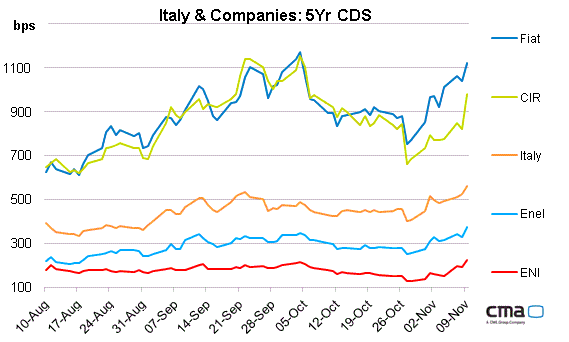
In the process, CDS wise, everything Italian widened - Source CMA:
[Graph Name]

Banks as well as Italy and Italian Companies - Source CMA:
Daily Focus Graph

Triggering in the process, flight to quality, Germany 10 year Government bond trending back to record lows - Source Bloomberg:

There is an interesting disconnect between the move in the 10 year German Bund and the Eurostoxx, while it had been moving in lockstep until recently, it appears the divergence between both does not look correct, so mind the gap - Source Bloomberg:
Volatility rising in the process as shown in the bottom level of the graph displaying 6 month implied volatility and V2X index.

France as well was not spared either with today's price action, given its exposure to Italy, with the 10 year Government bond spread level with Germany reaching another record in the process, coming close to 150 bps - Source Bloomberg.


OAT and EFSF Bonds widening versus German 10 year Government Bond yield - Source Bloomberg:
At this stage we know that EFSF will not be enough to deal with ongoing contagion to Italy.

The liquidity picture, not improving, new reserve period starting at the ECB hence the drop in the deposit levels at the ECB - Source Bloomberg:

In relation to liquidity dwindling as we move steadily towards year end, and dealers not particular eager to add risk towards year end, bid-offer spread are rising, but in relation to Italian debt, they have been soaring according to Bloomberg Chart of the Day relating to 2 year Italian Bonds bid-offer spreads:
By Matthew Brown - November 9 - Bloomberg:
"The gap between prices at which traders buy and sell Italian bonds has soared this week as market makers became less willing to deal in the nation’s debt, sapping liquidity from Europe’s largest bond market.
The CHART OF THE DAY shows the so-called bid-ask spread on Italian two year notes. The gap widened to 44 basis points today, the most since January, and up from 4 in March. Italian two-year yields climbed 98 basis points to a euro-era record 7.36 percent today, while 10-year yields climbed above 7 percent, the level that presaged Greece, Ireland and Portugal requesting international bailouts."

In recent post we have been discussing how banks will need to tackle revamped regulation needing them to beef up their core Tier 1 capital, as required by the European Banking Association.
We have already touched on the subject of DVA, bond tenders, debt to equity swap, upcoming deleveraging and of course reduction of appetite for risk with the reduction of the size of the trading book via attrition of Risk-Weighted-Assets.
As indicated by Bloomberg today by Liam Vaughan in his article "Financial Alchemy Foils Capital Rule as EU Banks Redefine Risk". It is worth mentioning the creativity of banks in dealing with capital rules imposed by regulators. When rules doesn't work your way, it is time to adapt:
"Banks in Europe are undercutting regulators’ demands that they boost capital by declaring assets they hold less risky today than they were yesterday.
Banco Santander SA, Spain’s largest lender, and Banco Bilbao Vizcaya Argentaria SA, the second-biggest, say they can go halfway to adding 13.6 billion euros ($18.8 billion) of capital by changing how they calculate risk-weightings, the probability of default lenders assign to loans, mortgages and derivatives. The practice, known as “risk-weighted asset optimization,” allows banks to boost capital ratios without cutting lending, selling assets or tapping shareholders.
Regulators in Europe, seeking to stem the region’s sovereign-debt crisis, ordered banks last month to increase core capital to 9 percent of risk weighted assets by the end of June."

And from the same article, an interesting comment from Adrian Blundell-Wignall deputy director of the Organization for Economic Cooperation and Development’sfinancial and enterprise affairs division in Paris:
"By allowing sophisticated banks to do their own modeling, we are allowing the poacher to participate in being the game-keeper”.

Yes, every bank uses their own models for calculating their RWA (Risk-Weighted-Assets) which are submitted once a year to national regulators according to the article.

Also from the same article:
"Sheila Bair, who stepped down as chairman of the Federal Deposit Insurance Corp. in June, has called Europe’s adoption of risk-weighting “naive.” The Washington-based regulator guarantees most consumers’ deposits in U.S. banks. “It is in a bank manager’s interest to say his assets have low risk, because it enables the bank to maximize leverage and return on equity, which in turn can lead to bigger pay and bonuses,” Bair wrote in Fortune magazine on Nov. 2. “Indeed, even during the Great Recession, as delinquencies and defaults increased, most European banks were saying their assets were becoming safer.
Some regulators, including Bair, have pushed for a leverage ratio that would require lenders to hold a fixed amount of capital against total assets.
One reason there’s a difference between risk-weighted assets and total assets is that some securities, such as certain sovereign bonds, carry a zero risk-weighting, requiring banks to hold no capital.

‘Gaming the System’

“A basic leverage ratio would be rougher, but it takes away the risk of gaming the system,” said Stephany Griffith-Jones, an economist and lecturer in financial markets at Columbia University in New York. “We need to move away from outsourcing regulation of the banks to the banks.” European bank stocks have tumbled 31 percent this year, valuing firms at 62 percent of tangible book value."
And the article to conclude quoting Mark Harrison, a Barclays
analyst, who is based in London:
“Gaming RWAs isn’t helpful, particularly if the objective is to convince the market to invest in banks again,” Harrison said. “The risk is that it’s counterproductive, because there
is even less faith in what the banks are telling you.”
Raising capital for Banks is therefore going to be an interesting exercise indeed in the coming months.

"Running a casino is like robbing a bank with no cops around." Ace Rothstein (Robert de Niro) in the movie Casino by Martin Scorsese

"Running an investment bank is like robbing a casino with no gaming regulators around."
Martin, Macronomics.

Stay Tuned!


Monday, 18 July 2011

Macro and Markets update - No test, no stress, no stress, no test...

All is in the title, as clearly Mr Market has not bought into the latest results for the European banking sector stress test. EBA's assumption of a 15% loss on Greek bonds and a 1 to 2 percent "haircut" on Irish and Portuguese debt, cannot be deemed serious.

Eight European banks failed the European Banking Authority's stress test: five from Spain, two from Greece and one from Austria.
Most were smaller banks. The aggregate shortfall was measured at 2.5 bln euro, but the EBA points indicated that the system raised 50 billion euro of capital between January and April this year, for the positive side.
16 banks have a projected Core Tier 1 between 5% and 6% at end-2012. Raising the threshold to 6% would mean a shortfall of over 10 billion euro.

Stress test puts banks' euro zone debt in spotlight

"The EBA data showed banks held 98.2 billion euros of Greek bonds (67% held by domestic banks), 52.7 billion euros of Irish sovereign debt (61% held domestically) and 43.2 billion to Portugal (63% at home). Applying more realistic losses of 40% on Greek bonds and 25% on Portuguese and Irish debt would add over 45 billion euros to capital needs."

Here is the picture for Italy in the CDS space as seen on Friday:
[Graph Name]

Update on Spanish Sovereign 5 year CDS as of the 18th:
[Graph Name]

France still leading the pack of Core Sovereign CDS 5 year movement:
[Graph Name]
France is now trading above 120 bps, as I previously posted, France is now at the same level Italy was in April 2011.

Portuguese 5 year banks CDS, following the results, well as expected, wider:
Daily Focus Graph

As well some Italian banks in the mix:
Daily Focus Graph
Swaps on Spanish and Italian banks led the rise in financial debt risk, with Banco Popular Espanol SA soaring 72.5 basis points to 648 and Mediobanca SpA up 22 at 238, both records.

For the SOVx 5 year index, here is the picture of the widening we have seen so far:
As a reminder, 1/15th of the Index is made of Greece, same applies for Portugal and Ireland.


Government bonds update, the 2 year picture - it ain't pretty for some...
Greece 2 year at 31.7%, Portugal at 18.24%, Ireland at 21.5%.


And here is the 10 year Government bonds morning snapshot:
Italy 10 year now closed to 6% (highest level since 1999, new week, new record), Spain at 6.249%. Greece, at 17.2%, Portugal at 11.87% and Ireland at 13.49%.


Italy approaching 7% would be a cause of concern. The 7% mark prompted its smaller euro partners to seek bailouts, namely Ireland, Portugal and Spain and Italy's economy is three times larger than the combined three. The extra yield investors demand to hold Italian 10 year debt over German bunds widened to 3.48 percentage points last week, the most since September 1996.
The overall Itraxx indices picture this morning was wider as well:
  • The iTraxx Financial Index linked to senior debt of 25 banks and insurers increased 5 basis points to 194 and the subordinated index climbed 8.5 to 338, both the highest since January.
  • The Markit iTraxx Crossover Index of 40 companies with mostly high-yield credit ratings increased 10 basis points to 470, the highest since the second of December 2010.
  • The Markit iTraxx Europe Index of 125 companies with investment-grade ratings rose 3.5 basis points to 126.25 basis points, the highest in more than a year.
That's the latest and I haven't even mention the action on the equity space. Nasty as well.

On a final note, Bloomberg's chart of the day today was an update on the Misery index:

 A 28 year high according to ZeroHedge.
"The CHART OF THE DAY shows the correlation between the U.S.
Misery Index, or the sum of the unemployment and inflation
rates, and measures of consumer confidence."

And it is only Monday...ouch...
To be continued...unfortunately...
 
View My Stats